
What appears in Link type
Your team’s saved setting controls the display:
An assessment can describe current or previous page evidence. Previous assessment describes saved evidence that is no longer confirmed current. Check its date and reason before relying on it.
Why two types can both be right
Choose Compare with AI above the table to show two columns:
These rows are illustrative. Chosen type records how your team describes a placement. AI page assessment describes matching links found in saved page evidence. A difference alone does not mean either description is wrong.
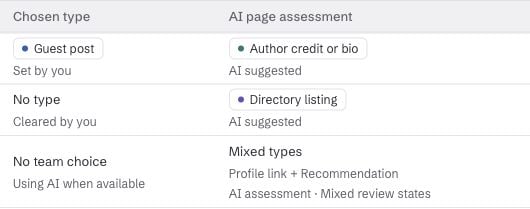
The Guest post choice describes the placement. Author credit or bio describes where the link appears. Example data.
autumn-campaign or a client name. They do not change the link type or the page assessment.
Change your team’s choice
If you can edit links, open a saved link’s details to choose a type or change its tags.
Use AI again does not run a new classification. It also does not approve a suggestion. If no assessment is available, the table still explains why a type is missing.
Read the evidence state
Open the link’s details to inspect the evidence date, assessment coverage and any reason a result is missing.
The source matters too: AI suggested is provisional; Reviewed has a recorded manual review; AI classified means AgentLinkOps accepted that assessment automatically. Reading any of these states does not approve a suggestion or start classification.
A page can contain several matching links. Mixed types means they have different assessed roles. 2 of 5 have types means three eligible occurrences still lack a type. Assessment coverage and type coverage can differ: an assessed occurrence can remain unclassified.
See evidence for several matching links
See evidence for several matching links
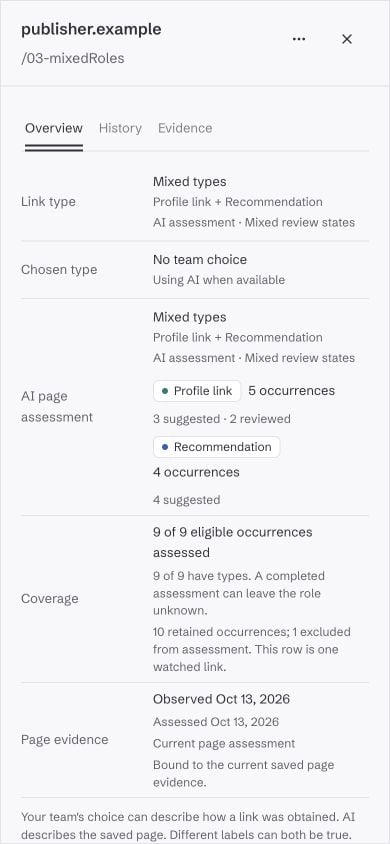
Example data: one saved placement has several matching links on its page, with two assessed roles.
Keep monitoring status separate
Paused means scheduled monitoring is paused for that saved link. It preserves classifications, team choices and tags. It does not tell you whether classification work is running or whether an assessment is current. Read monitoring and evidence history for the latest check and its date.Read types with an agent or the API
Saved-link reads and exports usecategory_contract: "link-category-v1":
These fields remain separate in concise and detailed results. Reading them does not fetch a page, run classification or change a choice. Legacy
type and type_source fields are compatibility values; use the category contract to interpret the table.
Filter saved categories and change a team choice
Filter saved categories and change a team choice
Read from your connected workspace. This example finds a current Profile link role, including one within Mixed types:Replace the project ID. The read requires
watches:read. When setting a scope, supply category or categoryState.Filters apply before counting and pagination. Reading previous evidence does not refresh it. The legacy
type filter retains its compatibility scope.Use set_link_type to choose a type, deliberately clear it with type: null, or return to AI display with intent: "automatic" and the current chosen_category.revision. A stale revision requires a fresh read before retrying. Tag operations organize links independently.See saved-link fields and filters for the full contract and availability for release boundaries.